

 Posts
Posts


With the rise of WEB centric systems and cloud computing, CRM companies and Economic Development Agencies would benefit most by federating small businesses and agents building enterprises from bottom up. Already on the WEB large numbers of agents and small companies have been architectured and federated in Enterprise systems in the Real Estate Industry, Travel Industry, Financing Industry. In the field of Software as a Service (Saas), the bottom up Enterprise approach has proven to be far more efficient than the Top Down Enterprise approach. In the field of export and interstate commerce, the same kind of Bottom Up Enterprise Architecture can be federated to increase sales interaction and cost efficiency.
In today's world, it is possible for a large number of people and small organizations working together to grow from their joint involvement. Small and medium size businesses that are grouped by government agencies with export clusters will benefit the most if they delegate business intelligence responsibilities to a common business development agency and if they use WEB centric CRM systems to provide information from bottom up as well as to receive information top down.
The Bottom Up Enterprise Architectures emerging from these federated organizations can be far more efficient than traditional structures in their domain because of the increased flow of information within the customer relationship value chains and because of the cost reductions arising from the use of Internet technologies on large territories.
Enterprise Architecture globally in commerce
As reported by Wikipedia
An enterprise architecture description gives a holistic, systematic description of an enterprise. It encompasses business functions, business process, people, organization, business information, software applications and computer systems with their relationships to enterprise goals.
Describing the architecture of an enterprise aims primarily to improve the effectiveness or efficiency of the business itself. This includes innovations in the structure of an organization, the centralization or federation of business processes, the quality and timeliness of business information, or ensuring that money spent on information technology (IT) can be justified.
One method of using this information to improve the functioning of a business involves developing an "architectural vision": a description of the business that represents a “target” or “future state” goal. Once this vision is well understood, a set of intermediate steps are created that illustrate the process of changing from the present situation to the target.
While enterprise architecture is closely tied to IT, it should be viewed in the broader context of business optimization in that it addresses business architecture, performance management and process architecture as well as more technical subjects.
It should also be noted that when redesigning work-flows to improve efficiency, Enterprise Architects considers Bottom Up as well as Top Down approaches. The goal is to gain efficiency.
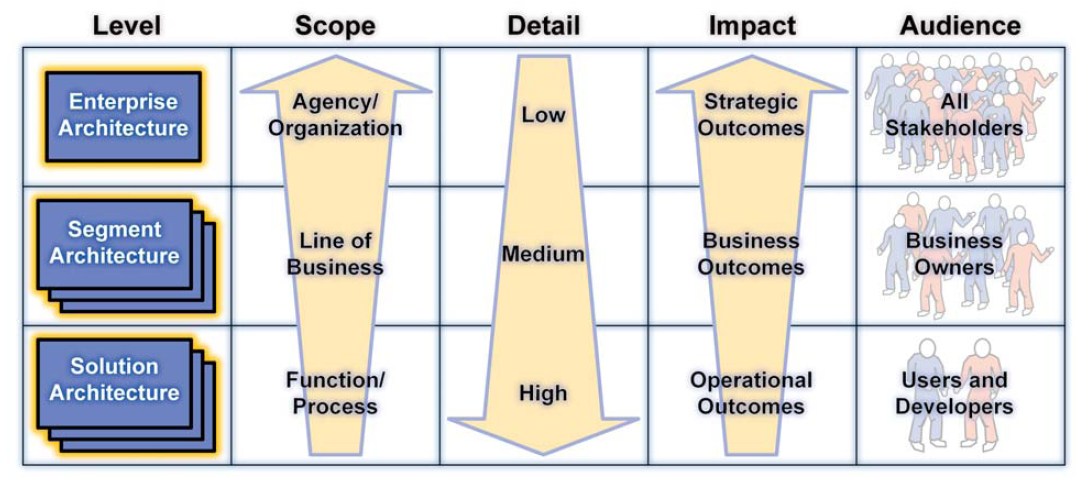
Therefore, in the world of Enterprise Architecture, it is out of the question to ideologically reject Bottom Up work-flows. This rejection attitude would defeit the whole purpose to adapt, improve and increase efficiency of existing Enterprise Architectures.
A Bottom Up Enterprise Architecture in computing: Cloud Computing
One of the most flamboyant example of the benefit of federating small organizations in a larger cohesive Enterprise built from Bottom Up is the business strategy underlying Cloud Computing.
Since 2000, Internet Technology companies are increasingly using Cloud Computing as a strategic way to grow. While the Enterprise application development with traditional software are complex, slow, and expensive, Cloud Computing emerged as a new Enterprise Architecture to address these problems.
According to Salesforce.com, inc,
Cloud computing refers to the use of Internet (“cloud”) based computing, storage and connectivity technology for a variety of different services. The pervasiveness of the Internet, along with the dramatic decline in the pricing of the technology components has enabled this new generation of computing, in which dynamically scalable and often virtual resources are provided as a service to both enterprises and consumers. Users need not have knowledge of, expertise in, or control over the technology infrastructure “in the cloud” that supports them.
In the context of enterprise business applications, cloud computing fundamentally changes the way business applications are developed and deployed. Application developers no longer need to create and manage their own infrastructure of servers, storage, network devices, operating system software and development tools in order to create a business application. Instead, the entire infrastructure is managed in the cloud, and developers simply use an Internet browser to access the development environment.
Salesforce.com, inc. has introduced its cloud computing platform http://www.force.com/ which became a strategic tool to increase the strength of the company on the market. Ranking 43rd in the Fortune 100, Salesforce.com, inc describes itself as an "Enterprise Cloud Computing Company " and one of the top companies in the U.S. . This position illustrate how the Bottom Up enterprise approach can be productive and efficient.
An other company, Taleo, has chosen cloud computing as part of its growth strategy http://new.taleo.com/resources/about-cloud-computing and launched Solution Exchange http://solutionexchange.taleo.net/sx/ . More than 4,200 organizations use Taleo for talent acquisition and performance management, including 46 of the Fortune 100 and over 3,500 small and medium sized businesses across 200 countries and territories.
Globally technological clouds help companies to expand from a Bottom Up Enterprise Architecture approach. His approach helps computing organization to grow their business faster and increase brand brand recognition faster and at a lower cost than traditional Top Down Enterprises.
Globally technological clouds help companies to expand from a Bottom Up Enterprise Architecture approach. His approach helps computing organization to grow their business faster and increase brand brand recognition faster and at a lower cost than traditional Top Down Enterprises.
Cloud Computing is a strong example of business development based on Bottom Up Enterprise Architecture approach within the product/development value chain.
The benefits of Bottom up Enterprise Architecture within the "Customer Relationship Value Chain" is not quite well understood as they are within the "Product Development Value Chain".
The benefits of Bottom up Enterprise Architecture within the "Customer Relationship Value Chain" is not quite well understood as they are within the "Product Development Value Chain".
A Sales Architecture : targeting the Enterprise companies
In the Customer Relationship Value Chain, Enterprise Business Representatives (EBR) rarely support Bottom Up business development strategies based on federating large numbers of small and medium size businesses.
In the traditional sales patterns Enterprise Business Representatives (EBR) methodically prioritize and prospect into enterprise companies structured with a president, vice presidents and divisions. Often, EBR are themselves part of regional teams, consisting of a Regional Vice President and a select number of Account Executives which focus on «Enterprise companies».
In this traditional Top Down sales model, leads, contacts, opportunities and sales originates from prospects at the top of the hierarchy list. EBR create and prioritize targeted account lists, methodically prospect into the accounts, and conduct high-level conversations with senior executives about their business operations.
In the traditional sales patterns Enterprise Business Representatives (EBR) methodically prioritize and prospect into enterprise companies structured with a president, vice presidents and divisions. Often, EBR are themselves part of regional teams, consisting of a Regional Vice President and a select number of Account Executives which focus on «Enterprise companies».
In this traditional Top Down sales model, leads, contacts, opportunities and sales originates from prospects at the top of the hierarchy list. EBR create and prioritize targeted account lists, methodically prospect into the accounts, and conduct high-level conversations with senior executives about their business operations.
This point of view is efficient to generate sales with large organizations but is ill equipped to efficiently address sales leads coming from large number of small organizations and individuals in the process to federate.
Increasing marketing attention to Bottom Up Enterprise Architecture
Over the past 5 years, convergence of communication and marketing tools has improved the capacity of aggregators to federate small and medium size businesses in cohesive business development Enterprises.
At the same time the economic crisis highlighted that traditional road shows, economic missions, magazine advertizing and trade shows and not necessarily the most efficient marketing tools.
Several industries already rebalanced their Enterprise Architecture, increasing access to the markets though Bottom Up Work-flows This strategy in the Customer Relationship Value Chain is often emerging using WEB centric software to federate large numbers of small and medium size organizations. The increased efficiency of the Bottom Up Approach is common knowledge in the Travel, Insurance, and Financial Service industries.
Several industries already rebalanced their Enterprise Architecture, increasing access to the markets though Bottom Up Work-flows This strategy in the Customer Relationship Value Chain is often emerging using WEB centric software to federate large numbers of small and medium size organizations. The increased efficiency of the Bottom Up Approach is common knowledge in the Travel, Insurance, and Financial Service industries.
- Would travelers deal with a travel agent who would not use an online reservation system and who could only sell travels in the one or two locations they visited in the past months?
- Would home buyers deal with a real estate agent who does not have MLS system and who could only access information on houses they visited?
- Would investors engage with agents who would not have access to online performance reports?
- Focus almost exclusively under the Top Down Enterprise Company marketing-sales model.
- Work mostly with the last opportunity contacts and neglect to systematically following up large number of leads;
- Rely on few trade show participation to increase their sales networks;
- Usually adopt a regional sales structure focusing to prospects located close to their office;
- Loose sales reporting capacities on all sales leads that cannot be converted immediately into opportunities.
In turn, their choices create opportunities for other organizations who see the benefits to better balancing their Top Down approach to the market with Bottom Up Enterprise Architectures.
For example, in computing, innovative companies increased performance through Cloud Computing.Likewise, in the Customer Relationship Value chain, other organizations are positioning themselves to federate large numbers of small organizations to increase access to market.
The Extended Enterprise for Export clusters
To customers on export markets, the Enterprise represents a combination of business organizations and governments that provide good and services. Often called the "Extended Enterprise", this point of view looks beyond each company and represents the complete value chain for good and services.
The Extended Enterprise is an enterprise architecture model raising leads and opportunities for a large number of small and medium size organizations federating within export clusters.
The Extended Enterprise is an enterprise architecture model raising leads and opportunities for a large number of small and medium size organizations federating within export clusters.

In defining the extended enterprise, managers determine which individuals and organizations they want to keep information about. They identify the kind of information they'd like to capture, and design systems that provide this information to the people who need it to facilitate their business. They then supply information to economic partners, employees, agent and distributors, partners and affiliates and prospective clients, which result in the extended enterprise.”
The Extended Enterprise can increase the value of its members who share common goals, policies and practices, and who delegate business intelligence, thus, increasing the flow of information though WEB Centric CRM Systems.
Globally, the Enterprise Architecture of the Extended Enterprise is on the Customer Relationship Value chain, what Cloud Computing is on the product development value chain: both Enterprise Architectures adopt a bottom up development strategy connecting with an array of small and medium size organizations operating under the same policies and practices increasing the efficiency for all.
The Extended Enterprise business model is a business opportunity in itself.
In 2010, the situation in sales and marketing have changed a lot. We believe it is time to adjust our sales and marketing strategies to the realities of the new economy. Everyone can see how the new economy has changed dramatically several industries such as publishing, job boards (Monster, Linkedin), advertizing (Google), travel, etc. IT companies are turning to the benefits of Cloud Computing to increase their power from bottom up with third parties. This is the new economy.
The business model of the Extended Enterprise on the customer Relationship value Chain relies on the same Bottom Up benefits than Cloud Computing does on the product-development value chain. Both
- Federate large numbers of organizations and professionals on large territories;
- Go beyond the conception of the Enterprise as the sum of the brick and mortar and the employees under the same roof.
Still several organizations have no incentive to drive the market and rapidly cannibalize their existing businesses for more cost effective, flexible, and efficient strategies for most of their clients.
At the same time those interested to cope with the rapid changes of the new economy and want their clients to take advantage of the tools available, can actually grab a larger part of the market by extending their reach in a permanent, systematic way on large trade regions.

No comments:
Post a Comment