

 Posts
Posts


Enterprise Architecture in commerce
Generally most sales organizations target, prioritize and prospect into enterprise companies to conduct high-level conversations with senior executives about their business operations and to find revenue opportunities. This point of view is limited since it neglects a large number of opportunities that can be captured from federating large numbers of small companies on large markets.
With the rise of WEB centric systems and cloud computing, CRM companies and Economic Development Agencies would benefit most by federating small businesses and agents building enterprises from bottom up. Already on the WEB large numbers of agents and small companies have been architectured and federated in Enterprise systems in the Real Estate Industry, Travel Industry, Financing Industry. In the field of Software as a Service (Saas), the bottom up Enterprise approach has proven to be far more efficient than the Top Down Enterprise approach. In the field of export and interstate commerce, the same kind of Bottom Up Enterprise Architecture can be federated to increase sales interaction and cost efficiency.
In today's world, it is possible for a large number of people and small organizations working together to grow from their joint involvement. Small and medium size businesses that are grouped by government agencies with export clusters will benefit the most if they delegate business intelligence responsibilities to a common business development agency and if they use WEB centric CRM systems to provide information from bottom up as well as to receive information top down.
The Bottom Up Enterprise Architectures emerging from these federated organizations can be far more efficient than traditional structures in their domain because of the increased flow of information within the customer relationship value chains and because of the cost reductions arising from the use of Internet technologies on large territories.
Enterprise Architecture globally in commerce
As reported by Wikipedia
An enterprise architecture description gives a holistic, systematic description of an enterprise. It encompasses business functions, business process, people, organization, business information, software applications and computer systems with their relationships to enterprise goals.
Describing the architecture of an enterprise aims primarily to improve the effectiveness or efficiency of the business itself. This includes innovations in the structure of an organization, the centralization or federation of business processes, the quality and timeliness of business information, or ensuring that money spent on information technology (IT) can be justified.
One method of using this information to improve the functioning of a business involves developing an "architectural vision": a description of the business that represents a “target” or “future state” goal. Once this vision is well understood, a set of intermediate steps are created that illustrate the process of changing from the present situation to the target.
While enterprise architecture is closely tied to IT, it should be viewed in the broader context of business optimization in that it addresses business architecture, performance management and process architecture as well as more technical subjects.
It should also be noted that when redesigning work-flows to improve efficiency, Enterprise Architects considers Bottom Up as well as Top Down approaches. The goal is to gain efficiency.
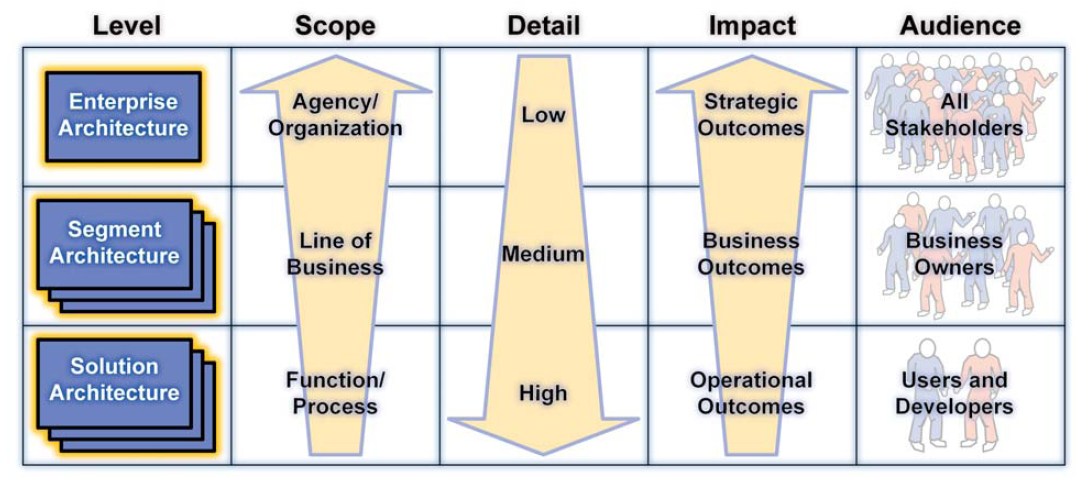
Therefore, in the world of Enterprise Architecture, it is out of the question to ideologically reject Bottom Up work-flows. This rejection attitude would defeit the whole purpose to adapt, improve and increase efficiency of existing Enterprise Architectures.
More...

No comments:
Post a Comment